
The most interesting conversation in hospitality design right now is not about what a space looks like. It is about what a space asks of the people inside it.
For a long stretch, the category rewarded novelty. A striking photograph was treated as a business outcome. Flash became shorthand for luxury, and every new property was pushed to declare itself more loudly than the one before.
That cycle has exhausted itself. Guests are harder to surprise and easier to tire. The properties that hold attention now are quieter, more grounded in place, and more generous about daily life. They are harder to design, and they are what the market is actually asking for.
From performed to inhabited
In a recent feature in Hospitality Interiors, Rowland+Broughton co-founder Sarah Broughton, FAIA, described the shift in plain terms. The strongest projects today, she said, feel “more connected, both to place and to the people who use it.”
That is a different brief than the one the industry has been writing for a decade. It reframes hospitality as a spatial condition rather than a program, with rituals embedded into the flow of buildings and landscapes. The architecture, the interiors, and the everyday use of the property are not three separate tracks. They are one continuous design problem.
A spatial condition, not a program. Rituals embedded into the flow of buildings and landscapes.
Three questions that change the result
Rowland+Broughton begins every hospitality project with three questions. They are not unique to the firm, but the team asks them early, and lets the answers shape the plan before the visual decisions are made.
What rituals does this space need to support?
Not activities. Rituals. The morning coffee that pulls a guest out of bed. The late-afternoon light that decides where people gather. The quiet end of the evening when the room needs to hold two people instead of twenty. A ritual requires a setting. If the setting is missing, the ritual does not happen, no matter how beautiful the space.
How does this space relate to its landscape?
Place is not a view through a window. It is material, scale, climate, and memory. A property that treats its setting as scenery will always feel interchangeable. A property that is built from its setting will not.
What does it feel like to live here, not just to look at it?
A photograph rewards novelty. A life rewards fit. The best projects survive the second visit, the slow morning, the unglamorous Tuesday. That is a harder standard than an editorial spread, and it is the one that matters.
Two projects, one approach
Two Rowland+Broughton projects in the Hospitality Interiors feature illustrate how those questions shape a built result.
First Light, Walla Walla Valley, Washington.
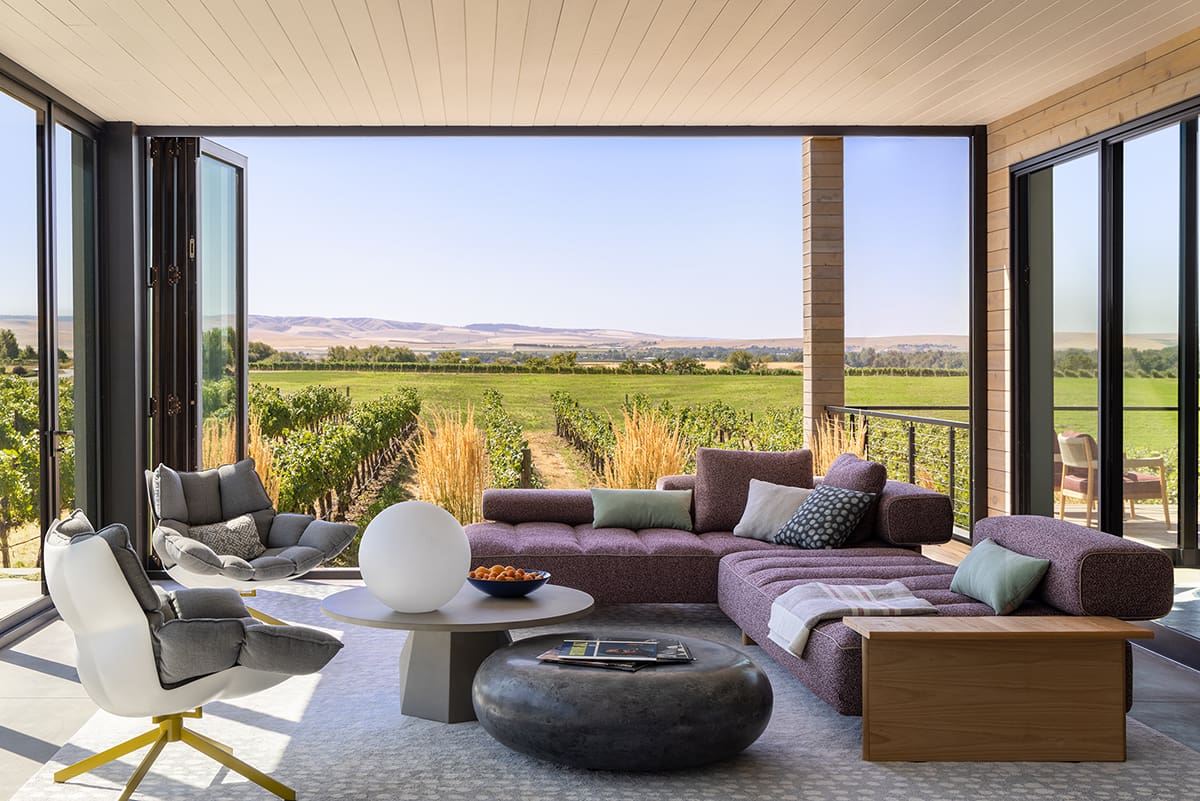
A residence for a wine enthusiast, set on ten acres of working agrarian landscape. Dark gray stone echoes the basalt rock that gives the region its grapes. Cedar recalls the stakes supporting the vineyard rows just outside the window. Four gable structures emerge from the ground as if the vineyard produced them. The house does not observe the valley. It participates in it.
The Rusty Parrot Lodge, Jackson, Wyoming.
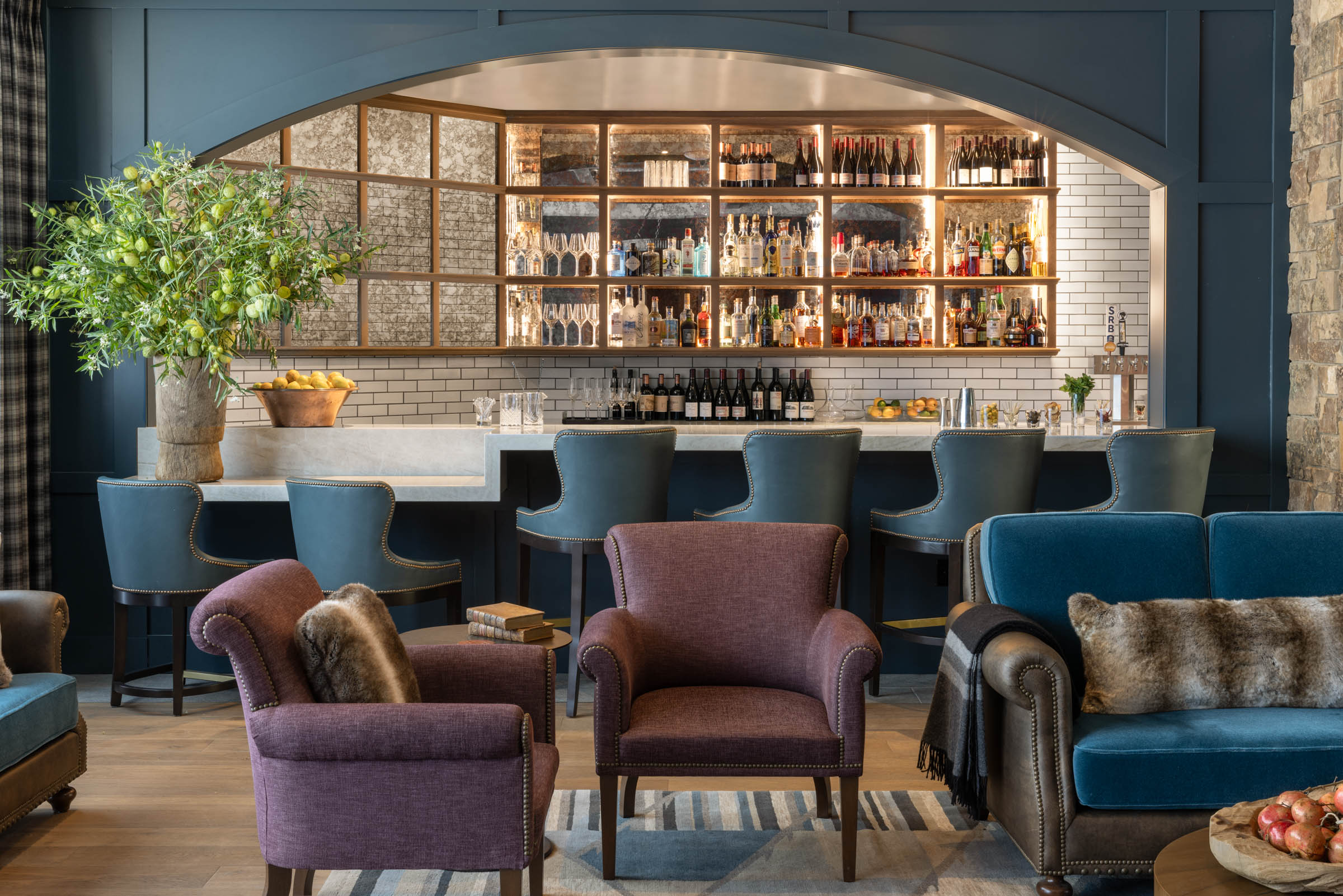
A replacement of a beloved inn lost to fire. The owners wanted the eccentric character of the original preserved, the amenities advanced, and the building rebuilt to a modern standard of stewardship. A commanding grand stair draws the scent of baking upward through three floors. A double-sided fireplace holds the lobby and barroom at the scale of a home, not a lobby. A series of found moments invite discovery rather than direct it. The lodge has a plan, but more importantly, it has a daily rhythm.
What this means for owners and operators
For owners planning a new property, a renovation, or a private residence with a hospitality program embedded inside it, the question to ask a design team early is not what the space will look like. It is what daily life the space needs to support, and whether the architecture and interiors are being developed from that question together.
A space built around spectacle will photograph well once. A space built around rituals will endure.
Read the full feature in Hospitality Interiors, Issue 123, January–February 2026.
See First Light: rowlandbroughton.com/project/first-light
See The Rusty Parrot Lodge: rowlandbroughton.com/project/rusty-parrot-lodge
The Convergent Method: rowlandbroughton.com/our-process